Listen to hear Barb Newman discuss how to:
- educate volunteers about Special Needs
- talk to kids about disability
- begin a ministry to and with persons with disabilities
Shaping Special Hearts 07/09 by CMConnect | Blog Talk Radio.
Listen to hear Barb Newman discuss how to:
Shaping Special Hearts 07/09 by CMConnect | Blog Talk Radio.
Shaping Special Hearts 07/09 by CMConnect | Blog Talk Radio.
You don’t want to miss next week’s show with my hero BARB NEWMAN from CLC Network! We are discussing inclusive placement, facility requirements, how to talk with kids about disabilities, and volunteer training. Barb is a treasure and I am blessed to know her!!
I have a good friend who has taught me more about empathy and coming alongside someone in the fellowship of suffering than anyone else. Her name is Gillian.
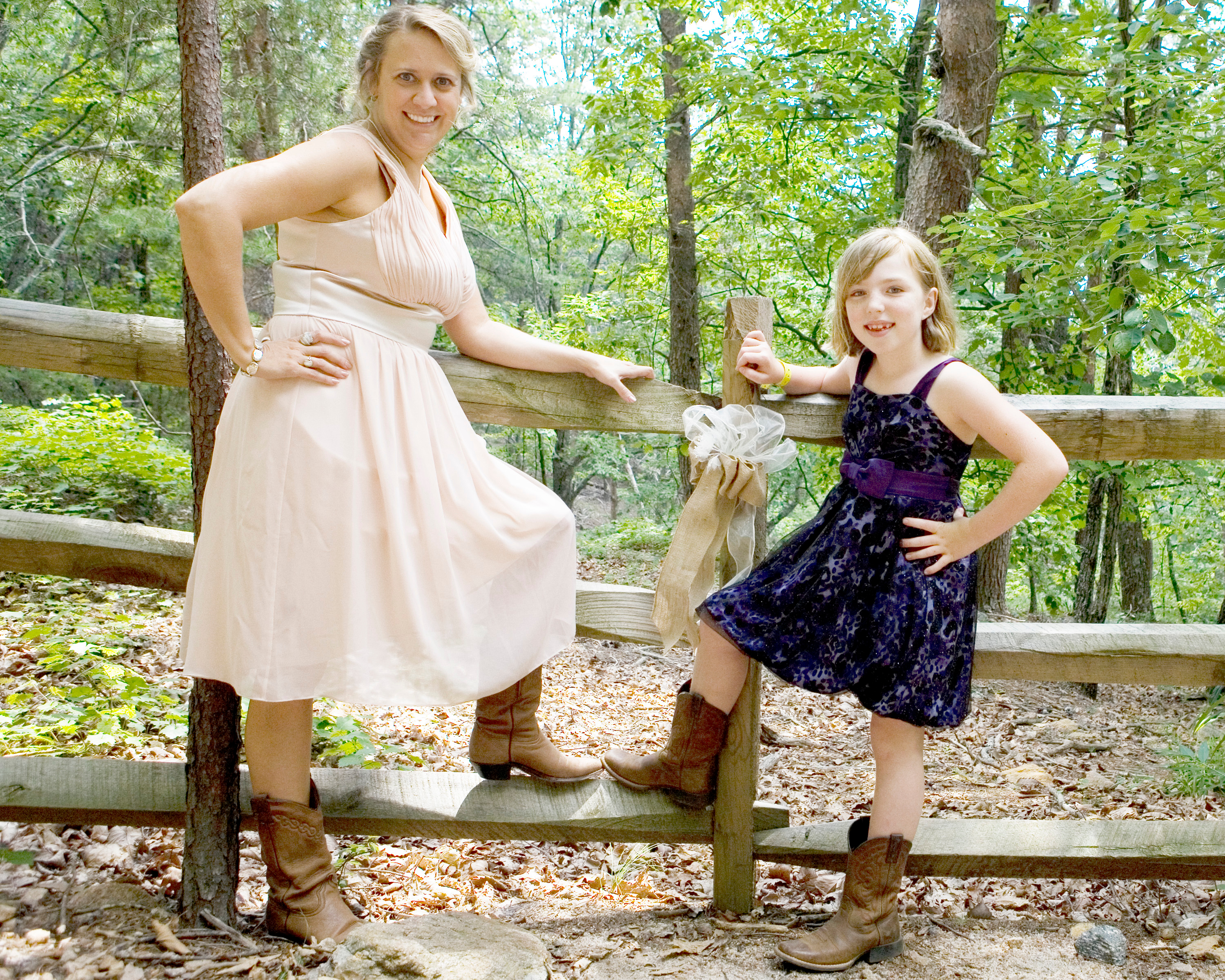
I’ve written about Gillian before, about how she learned to talk speaking the name of Jesus before any other word and about the honor I had to baptize her. (Maybe I will repost those in the following days so that you can get to know those stories if you don’t already.) If you subscribe to Standard Publishing’s Christian Standard Magazine or HeartShaper Sunday School Curriculum, you can see Gillian featured in an advertisement. She is featured because she is a wonderful, God fearing little girl who happens to be autistic.
Last night Gillian, her parents, my husband and I went to hear Temple Grandin lecture about autism. Dr. Grandin was born in 1947, at a time when it was common for children with autism-like symptoms to be diagnosed as simply “brain damaged.” Gillian wanted to go and see someone who has succeeded and not let autism overcome her strengths. Part of me just wanted to watch Gillian.
I know that she heard every word Dr. Grandin said about autism and strengths and the latent possibilities of this neurologically diverse population. With her usual intensity, she watched and recorded what she heard with her amazing brain. She uses the same concentration on all her passions – horses, animals in general, and Jesus.
Many times Gillian has interrupted my lesson with an insight that left me speechless. Her way of seeing and feeling things is a gift. And she feels deeply. So for me last evening, as much as Temple Grandin was the featured author and lecturer, Gillian was also an instructor. You see, Gillian feels deeply that she has something to offer the world. She isn’t sure what it is yet and she doesn’t know how to accomplish it, but she knows it is there and she knows she doesn’t want autism to prevent her from sharing her gift.
Her tremendous insights in areas of empathy and feeling are what Gillian teaches me. So often I am more than willing to let my weaknesses prompt me to “hide my light under a bushel.” But not Gilly. No, she is determined not to let fear and sensory overload stop her from being who God intends her to be. She has often asked what it means that the publishing company features her picture, wondering if she has some responsibility to fulfill. We keep telling her that she only needs to be herself because that is what has inspired so many people.
As for me, I don’t think I will ever stop learning from Gillian. Last winter when my son was in the hospital, he received this note from her.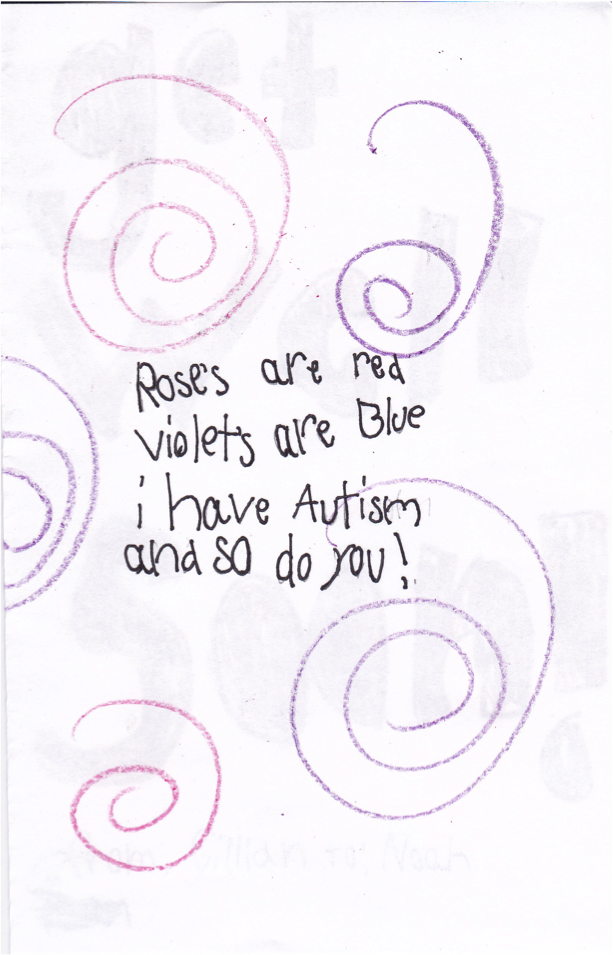
From deep inside autism, Gillian reached out to another who was struggling against the same condition. There was no part of her that was ashamed of their mutual condition – no part that even felt sorry for Noah. Instead Gillian elected to view it as her responsibility to use her disability as a bridge to reach another saying, “we are disabled together.”
Oh how I wish I had more friends like Gillian! I wish the church was full of Gillians who would reach out from their own condition to another and say “I am more like you than you think.” And I wish I felt the responsibility to reach out in empathy and solidarity as Gillian does.
Some might say that Gillian lacks the social inhibitions that dictate she more appropriately represent the autism that she and my son share. If so, I believe that lack of social grace is truly a grace in itself because it allows her to reach beyond herself with wild abandon.
Last night, she stood in line for almost an hour to have Dr. Grandin sign a book about autism heroes called Different Like Me. She reads this book all the time for inspiration for ways that she can overcome the many difficulties she faces every day. Something in me wanted to have Gillian sign it as well, for she is a hero of mine.

Gillian, I know your Mommy is reading this to you. You want to know what it means that you are my hero. You want to know what you have to do – what your responsibility is. With all my heart I want you to know that all you have to do is be who God made you to be. You are created in his image and he made you perfectly. When I look at you, I see God. And that is a gift to this world.
Sometimes a chance comes along to do something you never thought possible. I am a part of a chance like that now. Standard Publishing has contracted me to write lesson adaptations and instruction on how to include children with special needs at VBS 2014! This is an amazing opportunity and I am so thankful for the opportunity to share ways to make this possible. Check out this link for Jungle Safari 2014: Where kids explore the character of God. Next year, no one gets left behind on the safari to learn about how God is our Creator, Provider, Protector, Savior and King!!
What follows is a parable from real life about friendship and one becoming a member of the fellowship of another despite great differences. I am ever thankful for the man and the boy who made the story real, and to God for allowing me to witness it and tell it.
We attend a small church full of fun-loving, kindhearted Christ followers. Were I to tell you about each of them I would begin each introduction with, “Now there is Cathy…she is my favorite.” So will be no surprise to any of them to hear me begin “There is a man at my church named Ned and he is my favorite.”
It isn’t uncommon for Ned to call to check in on me every once in a while. He takes a personal interest in if my car is in fine operating condition and often inquires to my health and that of my husband. He is a builder of many things by trade. Often I am privileged to view of a picture on his phone of something he has built. We are friends.
Knowing Ned the way I do, it really didn’t shock me when he expressed a desire to take Noah fishing. Since we moved so close to the lake a year ago, Noah has constantly expressed a desire to go fishing. Were my father alive, nothing would have made him happier than spend a day on the banks of Lake Lanier with Noah. But I fear I have forgotten most of what I learned by his side.
When Ned heard of this need, he immediately saw an opportunity to share something. It should be said that he doesn’t have any formal training in special education. But Ned heard that Noah had an interest in something he was interested in and offered to spend the day with him.
Ned took this opportunity very seriously and called me several times to work through both our schedules to find a time for their outing. We worked for about a week until we could move around this and that to find an open morning. It took purposeful planning on his part to make a space for Noah during his busy week.
And they fished.
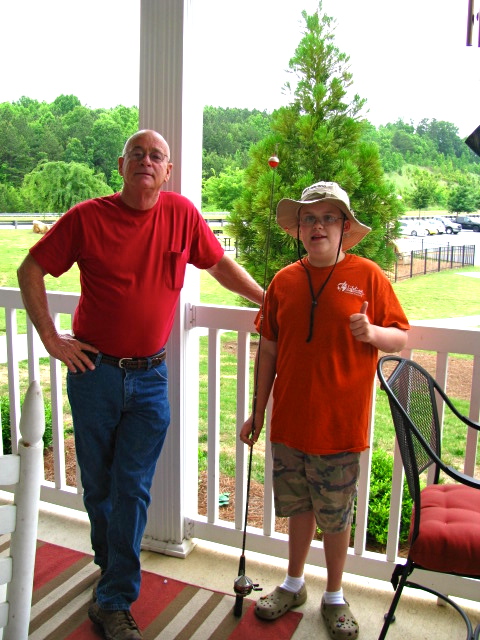
It should be said that Noah’s difficulty in large and fine motor movement make certain elements of fishing more complicated than others. For instance, Noah still lacks the fine motor skills to tie shoelaces. I wasn’t sure how he was going to bait a hook. Additionally, Noah is left-handed so standing behind him to model hand-over-hand is impossible (for me at least.) But I was sure if worst came to worst, Ned would just it for him. As for large motor skills, casting takes more large motor planning than you might think. I knew if Noah became frustrated by these two things before he even got his hook in the water all would be lost.
It was how these complex obstacles were completed seamlessly that began my reflection of this parable. Noah became proficient at baiting his hook. How? Well, Ned might not be instructed in occupational therapy principles to enable him to teach the correct over-under method, but as it turns out Ned is even more capable than that for you see, Ned is left-handed. It was much more natural for Ned to instruct Noah than it would have been for the best right-handed therapist. It seem that Ned had been especially equipped for this task without any preparation. (Maybe I’ll ask him to teach him to tie his shoes next.) I assume that observing Ned cast in all his left-handed glory allowed Noah the exact view he needed to calculate his motions and then imitate them.
Noah caught ten fish that day.
Allow me a moment to breakdown what may appear to be sweet story into teaching on accepting the other as a member.
The uniqueness of our neighbors is not related to those idiosyncratic qualities that only they and nobody else have, but it is related to the fact that God’s eternal beauty and love become visible in these unique, irreplaceable, finite human beings. It is exactly in the preciousness of the individual person that the eternal love of God is refracted and becomes the basis of a community of love.
Ned was able to, in openness, look beyond Noah’s idiosyncrasies and oddities to see him in the image of God – unique, irreplaceable, and precious.
4. Left-handedness…What makes me smile most is that Noah and Ned share something that Noah and I do not – left-handedness. They could instantly identify with one another. They probably have little else in common, but this simple identification made all the difference. The willingness to identify with another is a gift to them. Because of that willing identification, Noah sought to imitate the person before him.
PROXIMITY + INTENTIONALITY + OPENNESS + IDENTIFICATION = MEMBERSHIP
I have no doubt this will be the first of many outings for the” Left-Handed, Para-Autistic Fishing Club of Cumming.” And each will be a parable to itself testifying to membership.
The school year was almost complete and I was at our last IEP meeting. While these events once struck terror in my heart, this year we have been blessed with a wonderful team. Before we began, one of his teachers said, “Oh, wait! I have to tell you what happened at recess! I’ve never seen anything like it.” This is the story she told.
One of Noah’s best friends is a little girl who is blind. Each morning Lauren greets him in their homeroom by running her hands over his face, being gentle around his glasses. Then she quickly moves her hands to tickle his stomach and announces, “That is a Noah!” They play together at recess. She mostly sits and listens to the other children play or enjoys walking hand-in-hand with friends on the playground.
During the last week of school, his teacher looked up to see Lauren and Noah having a conversation. Noah, standing in front of her, had her cane in his hand and seemed to be asking her a question. The teacher observed Lauren smile and laugh, then nod at Noah. But what happened next was described as his teacher as something she has never seen before.
Taking his friend’s cane in his left hand, Noah placed his hand over his eyes with his other hand. Using only the noise of his friend’s voice, Noah began navigating the playground. The teacher said the girl would laugh as Noah would stop and call out something he had run into. This went on for ten minutes or so. Then Noah went back to her and took his place at her side.
When asked about what happened, here is what Noah said: “I just needed to know what it is like to be Lauren. If I am really going to be her friend, I think I have to understand her. Pretending to be blind helps me be her friend.”
I believe this reveals something crucial to us about how to include people “other” than us in our membership. Many times the first reply to involvement in a disability ministry is that the training of volunteers is problematic. We feel that there is no way that a volunteer can be appropriately trained to handle every potential situation that might occur when encountering someone with a disability. After all, they are so different an other than me. How can I prepare myself for such a task?
I think the answer lies in that very assumption – that it is a task. Yes, tasks require preparation and training. Friendship, however, does not. How much training have you undergone before beginning a friendship? Think of a particular friend. Did you read books to prepare yourself to have a relationship? Did you attend a seminar? Was there a training to undergo to plan for every eventuality and potential circumstance that a friendship might endure?
The answer is no. To be a friend, you do what Noah did. You take an interest in that person. You learn that person. What is it like to be them? What do they enjoy doing? You make an effort to identify with them. You spend time with them.
Benjamin T. Conner, in Amplifying Our Witness, writes
“Friendship shows a way of relating to a person with developmental disabilities beyond the medical model of care – an etiology, signs and symptoms, or a technical solution to the ‘problem’ of disability. In the medical model, disability is often characterized in a way similar to an illness; a specific, definable pathology and an individual problem to be eliminated – this model does not address the human, as such….Christian friendship – the affirming presence of another – transcends relational boundaries of likeness, instrumentality, or social exchange.”
Noah has no qualifications to be friends with Lauren. She is merely a friend. Are their exchanges atypical? Yes. But reviewing many of my friendships, I imagine our exchanges could also be described as atypical. Additionally, those social exchanges we define as critical to friendships vary from relationship to relationship. Honestly, there are some of my friends with whom I discuss my passions of theology or disability ministry in detail and others with whom I do not. That kind of social exchange is not necessary for me to consider one a “friend.”
Noah did not attend special training to acquire his friendship. Instead, he merely observed Lauren and learned her. He took this learning so far as to position himself in an environment where he might fully identify with her. Anyone who has sat by a friend in a hospital waiting room or funeral home has done the same. We can’t be prepared ahead of time for these situations; we learn as we become members of one another.
Memberships that are built on friendship are long lasting. They endure. When you become a member of another in this way, there are fewer ways this person is “other” than you. There are fewer opportunities for fear or misunderstanding based on differences and more room for a grace that flows from brotherly love.
Noah is a member of Lauren. He is her friend. Who will we extend the hand of membership to?
My mind wanders in strange directions. Sometimes I see things happen and spend months trying to piece together exactly what it was about said situation that reveals the work of God. This series on Membership is the result of such wanderings.
Looking back from the end of this school year, I can say it has been our toughest ever. Noah’s schedule went something like this:
I’d say that I don’t know how Noah survived the school year because lets not forget that he did all of this with autism. But something happened early on during the year that set our course on a different trajectory. Seeing it now from the not so distant future, I think I can draw some conclusions about how one small thing made all the difference.
Noise is still Noah’s largest area of sensitivity. He can compensate for sudden noise or even crowd related noise now. But at the end of a taxing day, prolonged noise is very difficult. So I wasn’t surprised to get a call from the principal at Noah school just a few short weeks into school.
Noah had already commented on having difficulty remembering and hearing his car rider number. He had asked for me to make a special tag to attach to his backpack to help him focus on the number in the crowded cafeteria where 200 plus kids gathered for car line every afternoon. I knew he was having difficulty so I was ready for the call.
She began, “Well, Noah is having some difficulty with the car rider area each afternoon. It is quite loud. He is becoming increasingly anxious. We just don’t think it is going to be possible for him to continue in the cafeteria.” There were several possible solutions to this scenario. I was prepared for each one.
What I didn’t expect is that she said none of these things. Instead, her solution was something much more than I could have anticipated.
She said, “What we are wondering is if we could make Noah a member of Safety Patrol? Putting him in a leadership role would be good for his self-esteem. We think that teaching him to say ‘Good afternoon” to children he does not know would be good for him socially. His speech therapist is willing to work with us on teaching him to say the phrases he would need to utilize. It would give him an instant peer group. We believe making Noah a leader would be good for all of us.”
To say I was speechless is an understatement.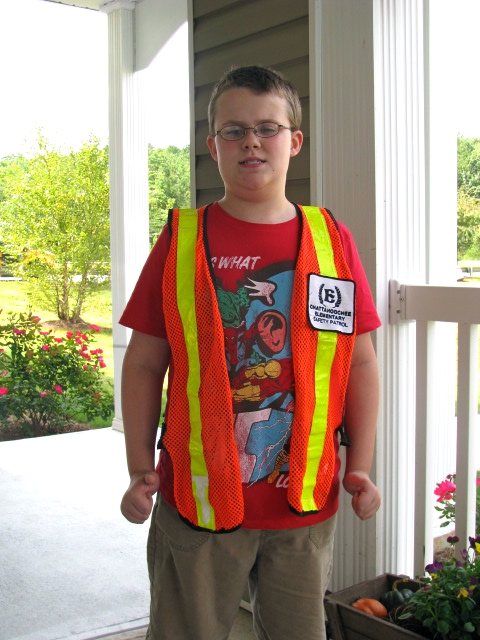
And so Noah began his first leadership role. And, as anticipated, he really took to it. One afternoon, just as the buses had beenloaded, the storm sirens exploded with news of an imminent tornado. Noah quickly asked a teacher how he could “help.” She confessed to me later that she didn’t even think, “Wait. This is Noah. Lets be sensitive to his autism.” Instead she just handed him a sign with an arrow on it and instructed him to tell children being evacuated down a hallway where to sit. With no panic and in clear diction, Noah managed the evacuees with ease.
Last week Noah graduated from 5th grade. (More about how he accomplished this in following blogs.) At the beginning of the ceremony, Noah and his friend Tony (also autistic) led the school in the pledge. Shortly after this school leadership teams were acknowledged and Noah stood to receive honor as a member of the Safety Patrol.
Allow me to be candid and logical for a moment. There is no outward reason Noah should have been a member of the Safety Patrol. Safety Patrol was invented to keep kids like Noah from getting themselves lost or in trouble. Who puts a barely intelligible, autistic child with very low verbal ability in an instructive role? Well, someone who believed he was already a member despite his inability to achieve success the way we typically measure it.
Wendell Berry has written, “A community is the mental and spiritual condition of knowing that the place is shared, and that the people who share the place define and limit the possibilities of each other’s lives. It is the knowledge that people have of each other, their concern for each other, their trust in each other, the freedom with which they come and go among themselves.”
Noah’s school made it possible for him to be an instant member of the community – despite his disabilities – by sharing that place with him. In essence, they created a place for him to be. And in sharing that created space, they did not place a limit on the possibilities of his life. And he thrived there.
Very often I am asked how it is possible to include the disabled in our church programming. I share this example of a school that did more than include. They created a space that made Noah a contributing member in a way that did not define and limit him. This act required no extra government funding or a one-to-one aid people are so fond of reminding me that churches do not have access to. It just required that a space be made.
The creating of that space made all the difference. It made him a member.



Good Read of the Week…this book is affirming and inspiring for parents of children with disabilities or for churches seeking to minister to and with those families1
A Better Way: Where Least Is Most: David Zachariah Glover: 9781462725007: Amazon.com: Books.
Getting ready for my next show on Tuesday, May 28th at noon.
Shaping Special Hearts – Episode 2 05/28 by CMConnect | Blog Talk Radio.
 vangierodenbeck